Search Products

ESD TR20.20-2025: What the New Handbook Means for Modern Manufacturing Facilities
Description
Introduction
Most ESD professionals are familiar with ANSI/ESD S20.20. It is the benchmark used across electronics manufacturing, semiconductor fabs, EMS facilities and assembly operations for establishing and maintaining an ESD control programme.
However, implementing S20.20 correctly has always depended on one important supporting document – the ESD TR20.20 Handbook.
The Electrostatic Discharge Association has recently released ESD TR20.20-2025, a complete rewrite of the handbook. While S20.20 tells organisations what requirements must be met, TR20.20 explains the practical engineering behind those requirements and provides guidance on how to implement them effectively.
For organisations planning ESD programme upgrades, compliance audits or new facility setups, the revised handbook is worth paying close attention to.
Why TR20.20 Matters
A common misconception is that passing an ESD audit automatically means a facility has a strong ESD programme.
In reality, many facilities satisfy the minimum requirements during an audit but still experience recurring ESD-related issues such as:
· Random field failures
· Yield loss during assembly
· Customer returns
· Unexplained device damage
· Process instability
The reason is simple.
Standards define requirements. Handbooks explain how those requirements should be applied in real production environments.
The revised TR20.20 places considerable emphasis on understanding ESD risks at the process level rather than treating compliance as a checklist exercise.
For semiconductor and high-reliability electronics manufacturing, this approach is becoming increasingly important as device sensitivity continues to decrease.
A Greater Focus on Practical Risk Assessment
One noticeable shift in the updated handbook is the focus on identifying actual ESD risks present within a process.
Traditionally, many ESD programmes concentrated on visible control elements such as:
· Wrist straps
· Flooring systems
· Workstations
· Packaging
· Personnel grounding
While these remain essential, today’s manufacturing environments contain many hidden charging sources that can easily escape routine inspections.
Examples include:
· Automated conveyors
· Test fixtures
· Tooling brackets
· Sensor mounts
· Machine guards
· Floating metallic structures
· Temporary modifications made during maintenance
These items often become isolated conductors without anybody realising it.
The 35-Volt Rule for Isolated Conductors
One area that deserves particular attention is the control of isolated conductors.
ANSI/ESD S20.20 requires that isolated conductors which come into contact with ESD-sensitive devices must be maintained below ±35 volts relative to the device being handled.
Many engineers are surprised when they first encounter this requirement.
The reason is that isolated conductors are often overlooked.
Unlike insulators, isolated conductors appear harmless because they are made of metal. However, if they are not grounded or equipotentially bonded, they can accumulate charge and discharge directly into sensitive devices.
In advanced semiconductor packaging environments, where device sensitivity may be well below 100 volts, even a relatively small potential difference can become problematic.
A Real Example from an ESD Audit
During an ESD assessment at an electronics manufacturing facility, our team was investigating recurring failures that could not be explained through standard workstation testing.
All routine checks appeared satisfactory:
· Wrist strap systems were functioning correctly.
· Flooring measurements were within limits.
· Workstations passed compliance verification.
· Ionisers were operating normally.
Yet occasional device failures continued to occur during handling.
A detailed process walkthrough eventually revealed the source.
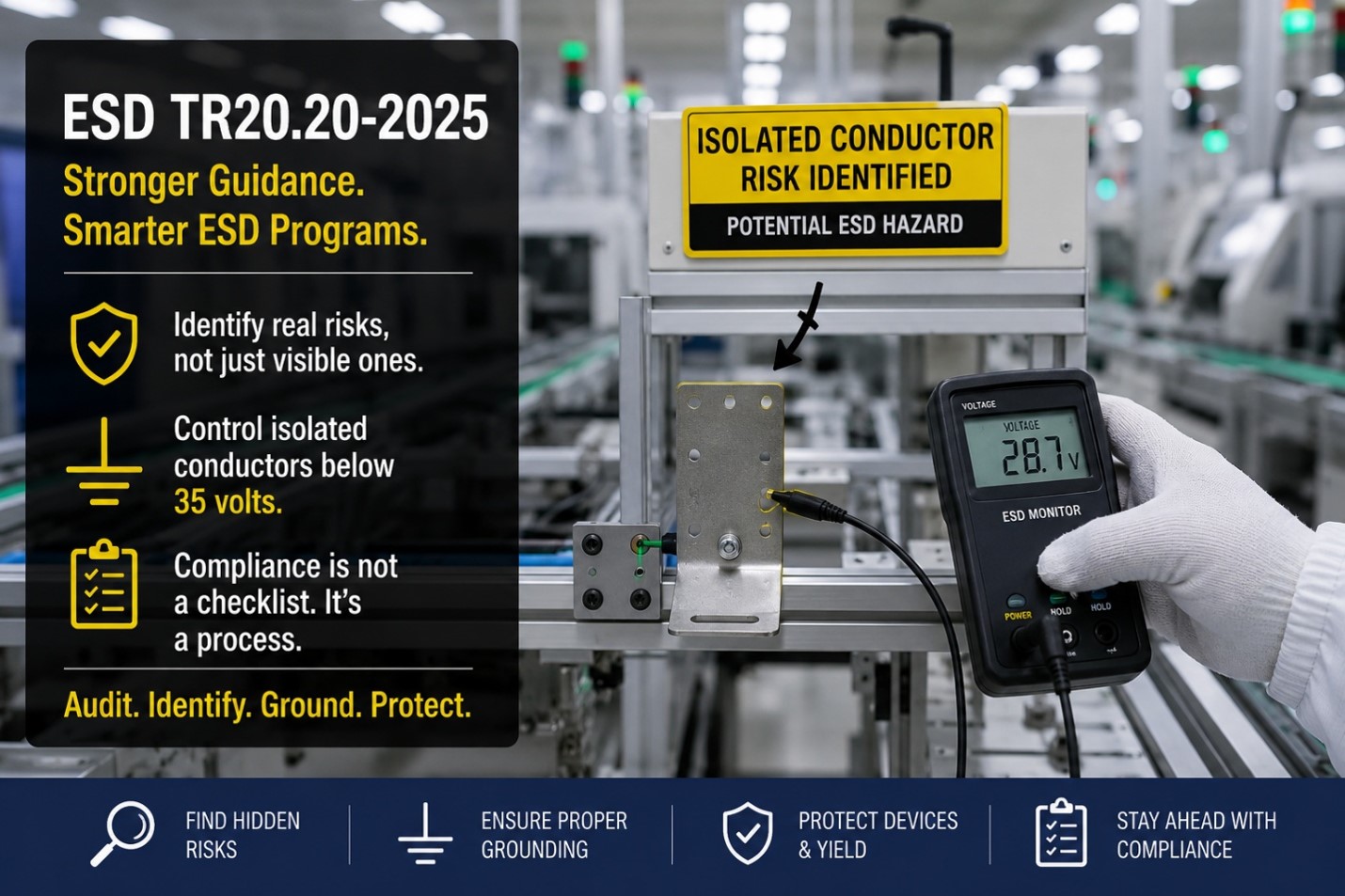
An aluminium mounting bracket had been added to a conveyor system during a maintenance upgrade. The bracket supported a barcode scanner positioned above the conveyor.
Mechanically, everything was perfect.
Electrically, the bracket was floating.
Since it was isolated from the conveyor frame by polymer mounting components, there was no reliable path to ground.
Under normal operating conditions, triboelectric charging from nearby moving materials caused the bracket potential to fluctuate significantly.
Because devices occasionally passed within close proximity of the bracket, the risk of discharge was present.
After the bracket was bonded to the equipment grounding network, measured voltage levels reduced substantially and the issue was eliminated.
The lesson was straightforward.
The ESD risk did not come from a sophisticated process tool or an expensive machine. It came from a small metal bracket that nobody had considered during installation.
Why Hidden Conductors Are Becoming More Common
Modern manufacturing environments are constantly evolving.
Equipment upgrades, automation projects and process improvements frequently introduce new metallic structures into the production line.
Examples include:
· Camera mounting systems
· Sensor brackets
· Robotics accessories
· Temporary maintenance fixtures
· Metal cable trays
· Equipment modifications
· Test fixtures
Many of these additions are mechanically secure but electrically isolated.
Over time, they become invisible to operators because they simply blend into the equipment.
Unfortunately, static electricity does not ignore them.
This is why periodic ESD audits remain critical even in facilities with mature compliance programmes.
Moving Beyond Annual Compliance Audits
The revised TR20.20 handbook reinforces an idea that experienced ESD professionals have known for years.
ESD control is not a once-a-year activity.
Processes change.
Equipment changes.
Products change.
Risk profiles change.
An ESD control programme that was effective three years ago may not adequately address today’s manufacturing environment.
Periodic verification should therefore include:
· Grounding system validation
· Isolated conductor surveys
· Ionisation performance checks
· Equipment evaluations
· Personnel compliance verification
· Process-specific risk assessments
The objective should not simply be passing an audit. The objective should be reducing actual ESD risk.
What Facilities Should Do Next
For organisations reviewing their ESD programmes in light of the new TR20.20 handbook, a few practical actions can deliver immediate value.
Review Existing ESD Risk Assessments
Many assessments focus heavily on workstations and personnel while overlooking process equipment.
Survey for Isolated Conductors
Conduct systematic inspections of:
· Conveyors
· Automated handling equipment
· Tooling
· Inspection stations
· Temporary modifications
Verify Ionisation Coverage
Confirm that ionisation systems continue to perform effectively under current production conditions.
Revisit Audit Methodologies
Move beyond simple pass-fail checks and evaluate actual process risks.
Train Engineering and Maintenance Teams
Many isolated conductor issues originate during routine equipment modifications.
Ensuring that maintenance personnel understand ESD principles can prevent new risks from being introduced.
Conclusion
The release of ESD TR20.20-2025 is more than a routine document update. It reflects the increasing complexity of modern manufacturing environments and the growing importance of risk-based ESD control.
As device sensitivity continues to decrease, organisations can no longer rely solely on traditional compliance activities. Hidden isolated conductors, process-induced charging and equipment modifications have become significant sources of ESD risk.
The facilities that achieve the best long-term results are not necessarily those with the largest number of ESD products. They are the ones that continuously evaluate their processes, identify emerging risks and address issues before they impact yield or reliability.
Sometimes, protecting a million-dollar production line begins with finding a floating metal bracket that nobody noticed.