Search Products

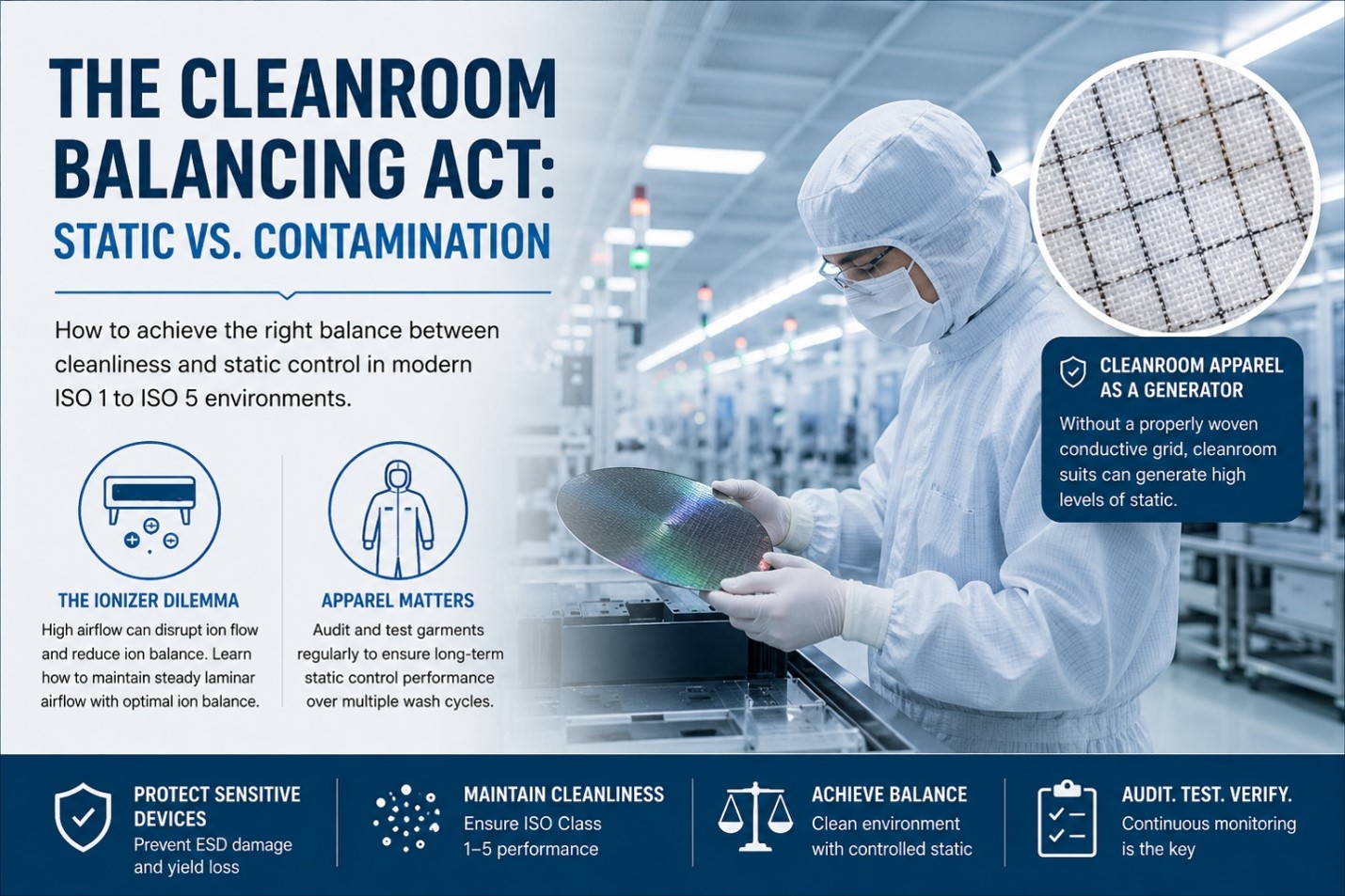
The Cleanroom Balancing Act: Managing Static Control Without Compromising Cleanliness
Description
Introduction
In semiconductor manufacturing, electronics assembly and other high-technology industries, cleanrooms are designed to achieve one primary objective: contamination control. Considerable effort goes into maintaining particle-free environments through carefully engineered airflow systems, HEPA and ULPA filtration, pressure differentials and specialised cleanroom garments.
However, maintaining a clean environment is only one part of the challenge.
As device geometries continue to shrink and electronic components become increasingly sensitive, electrostatic discharge (ESD) has emerged as an equally critical concern. In many facilities, engineering teams find themselves balancing two competing requirements. The airflow needed to maintain ISO Class 1 to ISO Class 5 cleanroom conditions can interfere with static control measures, while certain contamination-control materials and processes can unintentionally generate electrostatic charge.
Achieving the right balance between contamination control and static control requires a deeper understanding of how cleanroom systems interact with ESD protection measures.
Cleanliness Alone Does Not Guarantee ESD Safety
Many organisations assume that because a facility operates within a tightly controlled cleanroom environment, ESD risks are automatically minimised. In practice, the opposite can sometimes be true.
The same conditions that help reduce particle contamination can increase electrostatic charge generation.
Examples include:
· High-velocity airflow moving across surfaces.
· Low humidity environments.
· Synthetic cleanroom garments.
· Plastic process carriers and packaging materials.
· Automated handling equipment.
In advanced semiconductor facilities, where devices may have sensitivity levels below 100 volts, even small electrostatic events can result in yield loss or latent damage.
As a result, cleanroom design and ESD control can no longer be treated as independent disciplines. Both must be considered together during facility design and day-to-day operations.
The Ionizer Dilemma
Ionisation systems play a vital role in modern ESD control programmes.
Grounding can effectively eliminate charge from conductive objects and personnel. However, many materials used within cleanrooms are insulative by nature and cannot be grounded directly. Examples include wafer carriers, packaging materials, process equipment covers and portions of cleanroom apparel.
Ionizers address this challenge by generating positive and negative air ions that neutralise static charges before a discharge event can occur.
While the principle is straightforward, implementation within a cleanroom environment is often more complex.
The Impact of Laminar Airflow
Most semiconductor cleanrooms rely on vertical laminar airflow systems to maintain low particle counts.
Air is continuously supplied through HEPA or ULPA filters and moves downward at controlled velocities before returning through floor-level or wall-mounted return systems.
This airflow is essential for contamination control, but it can create difficulties for ionisation systems.
Common issues include:
· Ion displacement before reaching the target area.
· Uneven ion distribution across workstations.
· Longer discharge times.
· Increased balance drift.
· Reduced effectiveness in critical handling areas.
In some cases, ionizers that perform well in laboratory conditions fail to deliver the same performance once installed in a high-airflow production environment.
Achieving the Right Balance Between Airflow and Ionisation
Effective cleanroom ionisation requires a systematic approach rather than simply installing additional ionizers.
Conduct Airflow Mapping
The first step is understanding actual airflow behaviour within the cleanroom.
Airflow patterns are often affected by:
· Equipment placement.
· Process tools.
· Workstations.
· Personnel movement.
· Return air locations.
Detailed airflow mapping helps identify areas where ion transport may be disrupted.
Evaluate Ionizer Placement
Ionizer placement should be based on process requirements rather than convenience.
Critical handling locations such as:
· Wafer loading stations.
· Inspection areas.
· Packaging stations.
· Test operations.
should receive priority during ionisation design.
In many cases, localised ionisation systems positioned close to the process provide better results than relying solely on overhead units.
Measure Performance Under Actual Operating Conditions
Ioniser performance should always be verified under normal production conditions.
Key parameters include:
· Offset voltage.
· Decay time.
· Ion balance stability.
· Coverage area.
Testing during equipment operation provides a more realistic assessment than measurements taken during maintenance shutdowns.
Implement Preventive Maintenance
Contamination accumulation on emitter points can significantly reduce ioniser performance.
Routine maintenance schedules should include:
· Cleaning of emitter assemblies.
· Verification of balance settings.
· Functional performance testing.
· Documentation of results.
Periodic verification in accordance with recognised standards such as ANSI/ESD TR53 helps ensure long-term effectiveness.
Cleanroom Apparel: An Overlooked Source of Static Generation
Cleanroom garments are primarily designed to prevent particle contamination from personnel entering the manufacturing environment.
However, contamination control and static control are not always the same thing.
A garment may effectively contain particles while simultaneously generating significant electrostatic charge.
This issue is particularly important in semiconductor and electronics manufacturing where operators frequently handle sensitive devices.
Why Conductive Grids Matter
Modern ESD cleanroom garments typically incorporate conductive yarns woven into the fabric structure.
These conductive fibres create a network that allows electrostatic charges to dissipate in a controlled manner.
Without this conductive grid structure, friction generated during normal movement can result in significant charge accumulation.
Activities such as:
· Walking.
· Reaching.
· Bending.
· Handling materials.
· Sitting and standing.
can generate electrostatic potentials capable of damaging sensitive devices.
The problem becomes more severe in low-humidity cleanroom environments where charge dissipation occurs more slowly.
From an ESD perspective, a clean garment is not necessarily a compliant garment.
The Effect of Repeated Wash Cycles
One of the most common mistakes in cleanroom garment programmes is assuming that a garment’s ESD performance remains unchanged throughout its service life.
Repeated industrial laundering can gradually affect:
· Fabric resistance.
· Conductive yarn continuity.
· Surface charge characteristics.
· Groundability.
Although the garment may appear visually acceptable, its electrical performance may have deteriorated significantly.
For facilities handling Class 0 or ultra-sensitive devices, this deterioration can become a significant source of process risk.
Establishing a Garment Audit Programme
A structured garment audit programme helps ensure that apparel continues to provide both contamination control and ESD protection throughout its usable life.
Resistance Testing
Periodic resistance measurements should be performed to verify that garment conductivity remains within acceptable limits.
Testing should be carried out using recognised procedures and calibrated instrumentation.
Wash Cycle Tracking
Each garment should be assigned a unique identification number and tracked throughout its lifecycle.
Maintaining wash cycle records allows facilities to establish replacement criteria based on actual performance data rather than appearance alone.
Visual Inspection
Routine inspections should identify:
· Damaged conductive grids.
· Torn seams.
· Fabric wear.
· Broken closures.
· Contamination issues.
Physical damage can directly impact ESD performance.
Charge Generation Evaluation
Where appropriate, garments should be evaluated for their charge generation characteristics under simulated working conditions.
This provides a more realistic indication of how garments will perform during actual production activities.
Periodic Compliance Audits
Regular audits help verify that garment programmes continue to meet facility requirements and applicable ESD control standards.
Integrating Contamination Control and ESD Control
The most successful cleanroom facilities do not treat contamination control and ESD control as separate programmes.
Instead, they recognise that both disciplines influence product quality and manufacturing yield.
An integrated approach should include:
· Cleanroom airflow assessment.
· Ionisation system verification.
· Garment performance monitoring.
· Personnel grounding compliance.
· Packaging and material evaluation.
· Periodic ESD audits.
· Continuous improvement initiatives.
When these elements work together, organisations can achieve both contamination control objectives and robust ESD protection.
Conclusion
As semiconductor devices, advanced packaging technologies and high-density electronics continue to evolve, the relationship between cleanroom performance and ESD control becomes increasingly important.
Maintaining ISO-classified cleanliness is no longer sufficient on its own. High airflow environments can influence ionisation effectiveness, while improperly selected or poorly maintained cleanroom garments can become significant sources of electrostatic charge generation.
Manufacturers must therefore look beyond traditional contamination control practices and adopt a more comprehensive approach that considers both particle control and electrostatic risk.
A well-balanced cleanroom is one that not only protects products from contamination but also safeguards them from the invisible threat of static electricity. Achieving this balance is essential for protecting yield, improving reliability and supporting the production of next-generation electronic devices.